

Updated 3 months ago
Modular Mobile Sanitation Facilities | Smart & Sustainable Units
sidrahafeez
modular mobile sanitation facilities
Modular Mobile Sanitation Facilities: Smart and Sustainable
- In a world where hygiene, sustainability, and flexibility have become high-risk concerns, modular mobile sanitation units have become invaluable infrastructure products to both communities and businesses, as well as public spaces. Regardless of whether they are installed in a busy city or at a remote construction site, in a big international event, or even in humanitarian aid efforts, they are redefining the way we think of sanitation.
- These facilities have a future-ready model in terms of developing sanitation infrastructure with rapid deployment, customizable features, and environmentally friendly engineering.
The Emergence of New Mobile Sanitation Systems
Historically, the creation of modular mobile sanitation facilities took a long time in terms of planning, constructing, and laying. Speed and flexibility have become the most important considerations with the changing times, be it mobile sanitation facilities modules in the case of a festival, construction site sanitation facilities, or emergency sanitation facilities in case of a disaster area. This is where the mobile modular sanitation systems score.
- The design principles of modular designs enable the manufacturers to construct the prefabricated sanitation modules under factory conditions, maintain the quality, and cut down on the on-site construction schedule.
- These systems are easily transportable, can be installed easily, and are reconfigurable when the requirements change. What you get is sanitation infrastructure that grows in line with your requirements, be it long-term municipal use or the temporary nature of the application.
- This scalability is a game changer to organizations that require the sale of modular mobile sanitation facilities. Individual restroom blocks all the way up to complex sanitation systems with built-in water treatment are open to customization indefinitely.
Basic Elements of Modular Mobile Sanitation Stations
The core of any sanitation solution that works well lies in the technical systems to ensure that it becomes efficient, durable, and easy to use. The following is a list of the main components of the current ideal modular restroom facilities and portable modular restroom systems.
- Ready-assembled Sanitation Modules
Prefabrication guarantees a uniform quality and saves on the time of installation. Each module (toilet stall, handwashing station, available restroom, etc) is built away on site in controlled conditions. This will reduce wastage and also enable accuracy in engineering.
- Containerized Toilet Facilities
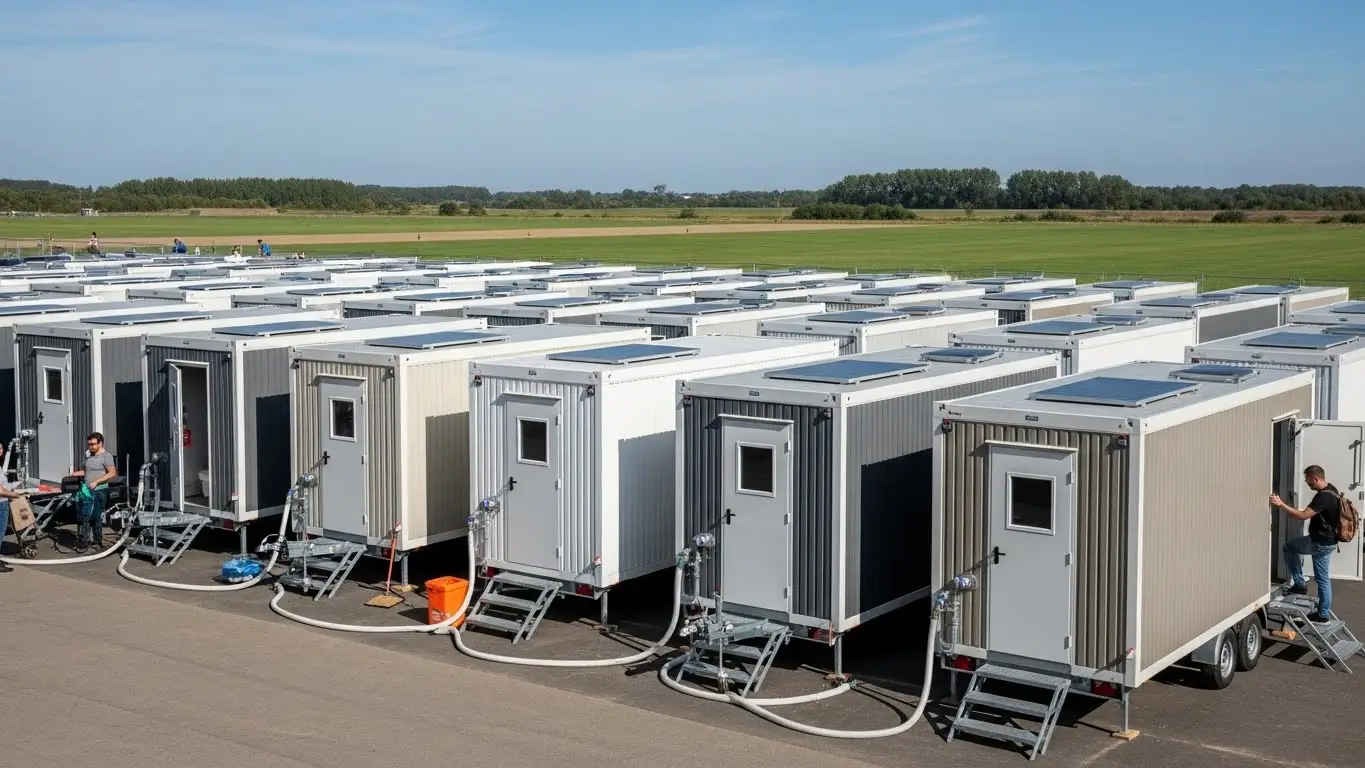
Container-based sanitation units are usually employed in environments that demand the utmost level of mobility and longevity, e.g., military deployments, mass festivals, or remote industrial locations. These containerized plants are also able to support heavy operations and environments, which makes them a great fit in industrial modular sanitation units and modular sanitation for refugee camps.
- Plug-and-Play Sanitation Units
Ready-to-use sanitation systems are plug-and-play systems that require a few setups. These systems are completely pre wired, pre plumbed meaning that they can be rapidly deployed and do not need as many technical requirements to be deployed on site. This comes in especially handy in emergency relief environments where time is of the essence.
- Sustainable and Water Saving Technologies
Sustainability is one of the main design principles in their water-efficient sanitation systems, as well as low-water toilet systems. Most contemporary modular systems incorporate greywater recycling, vacuum flush systems, or composting systems so as to minimize the impact on the environment without compromising the performance.
- IoT and Smart Monitoring
The development of the IoT, facilitating sanitation facilities, introduces novel intelligence to the sanitation infrastructure. The smart sensors keep track of the usage, supply levels, and maintenance requirements in real time. Sanitation monitoring through an automated system allows facility managers to streamline service times, saving them time and enhancing user satisfaction.
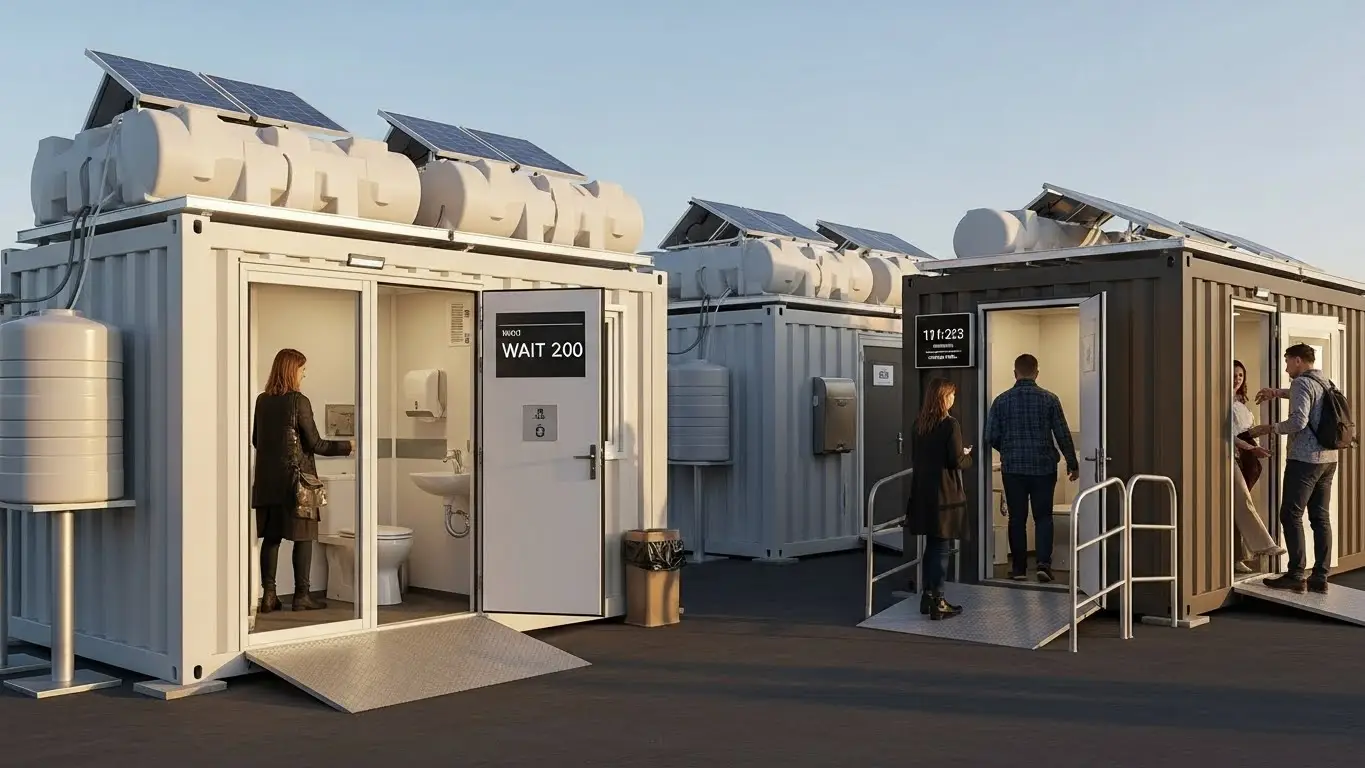
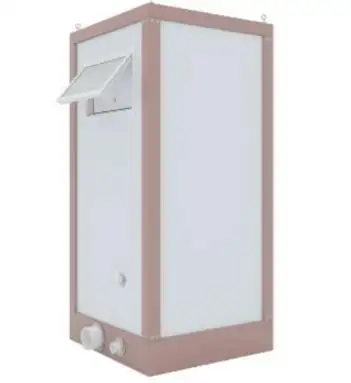
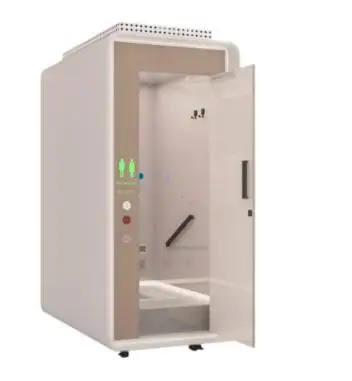
Self-Contained Mobile Toilet- TBOX GS W1
The Self-Contained Mobile Toilet TBOX GS W1 is one of the brightest examples of innovations in the modular sanitation area. This unit is designed to be as flexible as possible and with minimum dependence on the infrastructure, as it does not need any external water or sewage connection.
Key Features
- Built-In Clean Water Tank: This makes sure that the user can enjoy fresh water without depending on facilities on the site.
- Waste Tank with Easy Swap: Waste will be stored in a special tank that can be swapped very fast, enabling the unit to continue serving with little downtime.
- Water Saving Vacuum Sewage System: Uses a maximum amount of water, which lowers the total usage without affecting the hygiene.
- Space Saving and Eco- Friendly: The design is focused on space saving and environmentally friendly operation.
The TBOX GS W1 has a washbasin, a mirror, and user-friendly mechanisms, making it the future of smart modular sanitation infrastructure - the ideal product to install where conventional sanitation infrastructure would not be possible.
Why Do We Prefer Modular Portable Sanitation Facilities?
- Quick Implementation and Scalability
The rapid deployment of modular systems is one of the greatest benefits of modular systems. Regardless of whether you require mobile sanitation units at a cultural festival to serve the general population or you require temporary toilets at a distant research station, modular units take the shortest time to be transported and operational.
- Customization & Flexibility
Modular design allows you to select configurations that would meet your needs precisely - from a simple sanitary unit to high-end, fully equipped restroom facilities with touchless interfaces, climate control, etc. Expansion and downsizing of facilities could also be done as demand decreases and increases.
- Enhanced Hygiene & Safety
The current modular sanitation systems tend to include touchless hygiene systems and minimize the possibility of contamination, which enhances user trust. Digital management systems and smart sensors offer real-time information about the cleanliness and use, ensuring high hygienic standards of operations teams.
- Over Lifecycle Cost Effectiveness
Although the price of the first one may be higher than the basic portable toilets, modular systems will bring long-term benefits in terms of durability, less expensive maintenance, and reuse in numerous locations and uses.
Industrial Applications
Modular sanitation systems are not a one-size-fits-all. The fact that it is flexible means that it can fit in many sectors:
- Building Sites and Industrial Sites
Big construction projects do not have permanent sanitation infrastructures at the initial stages. Construction workers use safe and reliable restrooms and hygiene facilities built in a modular format that can be transported to their construction site as the project develops.
- Meeting, Festivals, and Entertainment Places
Massive audiences require effective and hygienic sanitation. Mobile sanitation units serve events and festivals to ensure the comfort of the participants, assist in the high throughput and speed during the serving between event days.
- Humanitarian Support & Disaster Relief
During a post-disaster period, the most important task is the rapid establishment of a sanitation regime due to the health of the population. Disaster relief sanitation units are modular units that provide quick, sure, and decent solutions to the affected community.
- Remote & Underserved Areas
Areas that lack infrastructure have an opportunity to gain a lot by having portable sanitation to serve remote areas. Modular units can become one of the main elements of enhancing the health condition of the community and facilitate the aim of sustainable development.
- Cities, City Growth, and Urbanization
With the rising population in cities, it is essential to incorporate scaled-up sanitation. Public hygiene and city sanitation systems. Mobile sanitation of places and urban areas contributes to the adjustment of the municipalities to the changes in the population and patterns of use.
Engineering Behind Modern Modular Sanitation
In order to genuinely enjoy modular mobile sanitation systems, it is better to know the engineering principles that cause them to be robust, efficient, and future-ready.
- Structural Materials and Durability
Modular units of high quality are commonly constructed using such materials as reinforced steel frames, corrosion-free panels, and antimicrobial surfaces. These materials are long-lasting, have resistance to weather extremes, and are easy to clean.
- Vacuum and Low Water Technologies
Other innovations, like the vacuum flush toilets, have contributed much to the reduction of water consumption, and therefore, low water toilet systems are best suited in regions with scarce resources. Vacuum systems are also efficient in sewage handling, which favors compact waste storage design.
- Integrated Water Management
Modern systems can have greywater recycling, auto dosing, and smart control to maximize water consumption and curtail operating expenses.
- Digital & Sensor Integration
Sensor units of sanitation check the occupancy, water status, and waste capacity. Custodial teams can receive alerts whenever maintenance or cleaning is required, and unnecessary checks are minimized, which ensures constantly safe conditions.
Sustainability: One of the Main Pillars
Sustainability is not a choice in the modern environment where people are so eco-conscious. Modular sanitation facilities are helpful in various aspects to make infrastructure greener:
- Eco-Friendly Materials
Environmental impact is lowered by taking sustainable production methods and recycling parts that can be recycled, and, at the same time, improving the lifespan of every unit.
- Water Conservation
These facilities help in saving a lot of water as compared to conventional flush toilets through water-efficient sanitation systems and vacuum technologies.
- Solar and Energy Efficiency
Others have solar-powered sanitation units, and they are self-reliant and are suited in off grid areas.
Conclusion
The modular mobile sanitation facilities structures of today are not only restrooms but intelligent adaptive mobile hygiene structures that have been designed to meet the demands of the dynamic world. To get the latest modular sanitation knowledge and solutions that can be applied to all settings and budgets, go to Junhan Technology.